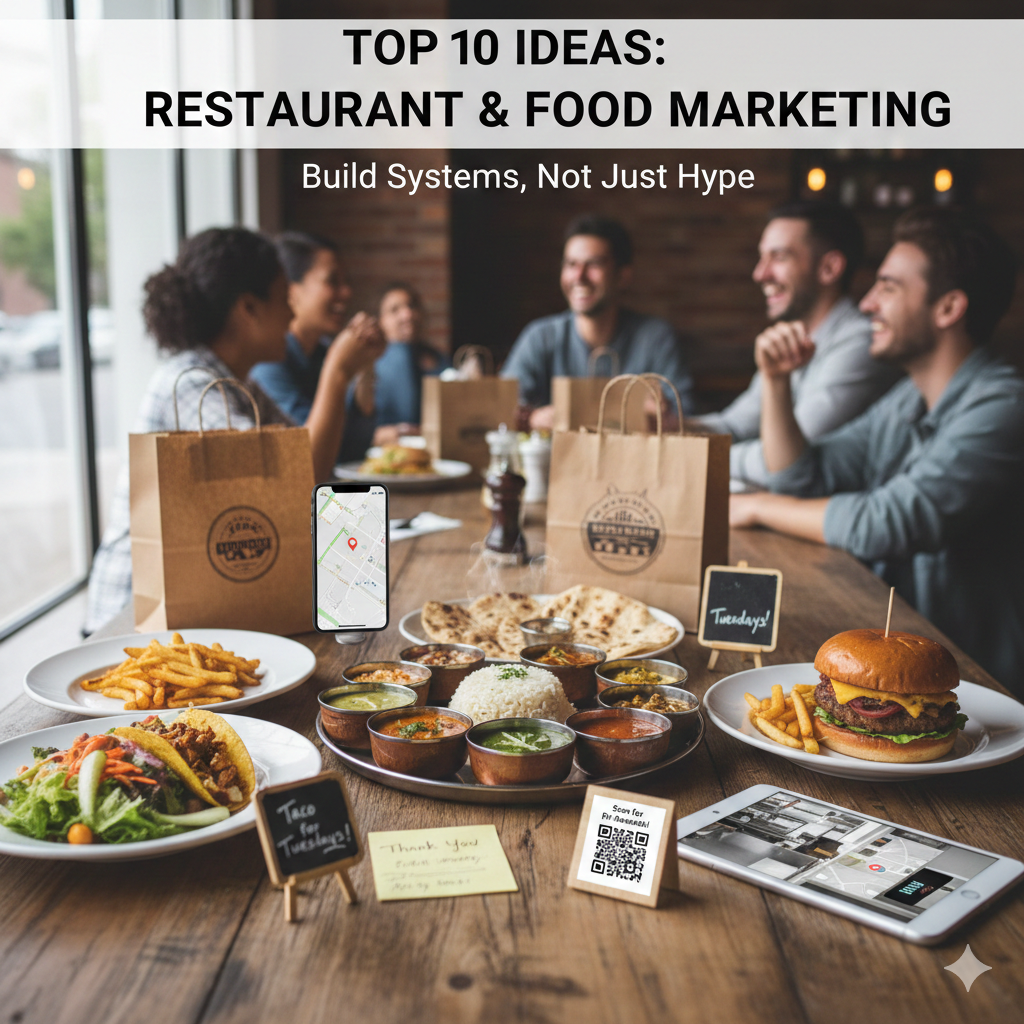
Let me explain the best marketing practices for the present time properly. Most people think marketing a restaurant is about taking high-quality photos and posting them on Instagram. While visuals matter, they are just the surface. If you don't have a system behind the scenes, you are just spending money on "noise."
In the food business, your biggest constraint isn't usually your food—it’s the friction between a hungry customer and their first bite. If we break this down, the goal isn't just to be seen; it's to be remembered and trusted.
Here is a grounded way to look at marketing for a restaurant or food business.
1. Own Your Local Search Presence
Most food decisions happen in a moment of immediate need. People search "food near me" or "best biryani in [City]." If your Google Business Profile isn't optimized, you don't exist in that moment.
The Logic: You need to be where the intent is highest.
The Action: Keep your hours updated, respond to every review (even the bad ones), and upload real photos of your menu.
2. The "Real Food" Content Strategy
We have seen enough over-edited, slow-motion videos of cheese pulls. People are starting to crave authenticity. Show the kitchen. Show the prep. Show the bags being packed for delivery.
In practice: Transparency builds trust. When people see a clean kitchen and a disciplined team, the food tastes better in their minds.
3. Hyper-Local Meta Ads
Broad marketing is a waste of capital for a physical restaurant. You don't need the whole city to know you; you need the people within a 3–5 km radius to know you.
The System: Use Meta ads with a tight geographic radius. Focus on a specific "hero dish" rather than the whole menu. It reduces the customer's decision fatigue.
4. Build a "Direct-to-Consumer" Database
Relying solely on Swiggy or Zomato is an irreversible risk for your margins. You are paying for the same customer over and over again.
The Shift: Collect phone numbers or emails through a simple QR code at the table or a small discount on the first direct order. When you own the data, you can bring people back without paying a commission to a third party.
5. Micro-Influencers Over "Foodies"
The era of the "Mega Influencer" is fading. Their followers are scattered globally. Instead, find local people who actually live in your neighborhood and have a small, engaged following.
The Reason: A recommendation from a neighbor carries more weight than a paid ad from a celebrity. It feels like a tip, not a pitch.
6. The "Anchor Event" System
Consistency is hard. Instead of trying to be "busy" every day, create a system where one day a week is an anchor.
Example: "Taco Tuesdays" or "Sunday Family Brunch."
The Benefit: It creates a predictable spike in revenue and helps your staff prepare better, reducing waste and stress.
7. Google Review Automation
Most people only leave reviews when they are angry. You have to balance the scales.
The Process: Train your staff to ask for a review at the moment of highest satisfaction—usually right after the meal is finished but before the bill is paid. A simple QR code on the bill folder makes this frictionless.
8. Strategic Sampling
If you have a high-margin item that people love once they try it, give it away in small portions.
The Practicality: Sampling is the fastest way to overcome "new customer hesitation." It’s an investment in customer acquisition, not a loss of inventory.
9. Optimize for the "Unboxing" Experience
If you do delivery, the bag and the containers are your "storefront."
The Detail: A handwritten note or a small complimentary extra (like a specific dip or a mouth freshener) changes the perception of value. It signals that someone cared about the order.
10. Community Integration
Stop thinking like a business and start thinking like a neighbor. Sponsor a small local sports meet or provide snacks for a neighbourhood meeting.
The Long-term View: This builds "social capital." When the community feels a sense of ownership or connection to your brand, they become your most resilient marketing engine.
A Final Thought
Most restaurant owners fail because they chase "viral" moments and neglect the system. Marketing isn't a one-time event; it’s the compounding effect of small, predictable actions. On paper, these ten points seem simple, but the difficulty lies in the execution.
Choose two or three of these ideas and execute them with total discipline for 90 days. That is how you actually build a brand that lasts.
Comments
Be the first to leave a comment!
Leave a Comment